A Better Way to Stretch

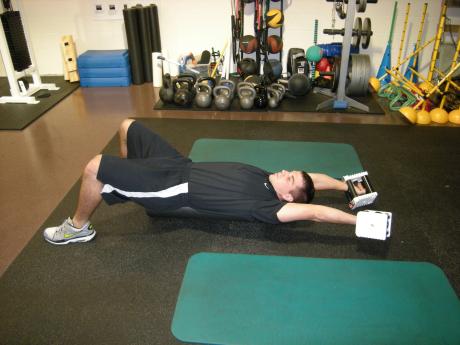
Lat EQI

I get a lot of interest in eccentric quasi-isometrics (EQI’s) from both my online clients and people who read my blog, so I figured I’d write something up to help explain what they are and how I use them.

EQI’s are an active stretch – without getting into the nitty-gritty science behind them, our goal is to try and actively hold an isometric position (such as the midpoint of a dumbbell fly or split-squat) for an allotted period of time.  We generally start with 30 seconds, and work our way up to a 2 minute hold.  If they can get to 2 minutes, we start adding weight.

However, holding the midpoint position is impossible.  This is the “active” portion of the stretch – we’re trying our best not to move, but we slowly lower over time as fatigue sets in.

One of the keys with EQI’s is to stabilize our body appropriately.  If you’re sinking into a split-squat or Bulgarian Split-squat and you’re not stabilizing with your glutes and external obliques, you’re going to reinforce poor stabilization patterns (such as an anterior pelvic tilt and increased lumbar lordosis).

If you’re doing an EQI for the lats (as pictured above), you have to think about maintaining a neutral lumbar spine, versus allowing your lower back to arch excessively.

I often use EQI’s at the end of a workout.  Not only does it help restore a better resting length to specific muscles, but it also develops strength and stability in the end range of motion.

If you have a client that consistently tests stiff or short, consider placing an EQI at the end of their training sessions.  Do these for a few weeks, and then re-test.  If they are doing them appropriately, you should see a nice change.

Stay strong

MR

 
click here

Related Posts

No related posts.

This entry was posted in Programming and tagged , , , . Bookmark the permalink.

6 Responses to A Better Way to Stretch

  1. Arthur Lange says:

    Mike,
    If someone has a significant amount of adhesions or trigger points, will EQI’s be able to partially reverse those without soft tissue intervention? Or would you need to get work done to make a dent into those first before the EQI’s would have much of an impact?

  2. Arthur says:

    I’m definitely not a soft-tissue expert, so I would have to defer to someone that is to give you a qualified answer.
    Maybe Bill, Patrick Ward or another soft-tissue expert who swings by could chime in?
    Thanks
    MR

  3. Jeremy Stone says:

    Hey Mike,
    Whats a good book or website to learn about EQI more in depth.

  4. Patrick Ward says:

    Arthur,
    One of the issues with “trigger points” is that they can be resistant to stretch. So, trying the EQI may ilicit some discomfort, or you may not even be able to get into a good stretch position (or you may get into that position in a way that re-enforces poor stabilization, as Mike talked about in the article).
    An example of this would be holding a chest fly EQI. If the pecs are riddled with ‘trigger points’, you wont be effectively getting into a stretch position, and you will probably just be creating a whole bunch of guarding or reflexive muscle contraction to prevent getting the arms back there (or you will excessively arch the lower back to ‘artificially’ get into the stretch position). Performing some soft tissue work prior to performing the EQI may get you a better result.
    Patrick

  5. Charles Bean says:

    I’m with Patrick on this one – I’ll usually apply some medicine ball or softball SMR to the area before using EQI’s. Especially on the pecs and hamstrings.

  6. Jess says:

    Had first ever ART treatment on my shoulder (about time) & it made a world of difference to performance of Pec & Lat EQI’s. Love results from Bulgarian Split Squat EQI’s – not too comfy though hey :-)

Leave a Reply

Your email address will not be published. Required fields are marked *

*

You may use these HTML tags and attributes: <a href="" title=""> <abbr title=""> <acronym title=""> <b> <blockquote cite=""> <cite> <code> <del datetime=""> <em> <i> <q cite=""> <strike> <strong>