

How do we, as coaches, construct training programs for those who are in persistent pain?
Our industry traditionally talks about either enhancing performance in people without pain OR rehabbing a person’s pain away.
More often than not, however, our clients are in a gray area between the two extremes.
While we may not have a silver bullet to fix people or solve pain, what can we, as trainers, do to still help people improve their fitness and wellbeing?
I spent years as a collegiate Strength and Conditioning Coach at a Division 1 institution, where treatment for injured athletes was always a team effort between a world-class Strength and Conditioning, Athletic Training and Physical Therapy staff.
Then I entered the private sector with general population clients and the high majority of the people I work with suffer from persistent pain.
Should I turn these people away?
Should I refer them to a Physical Therapist?
The truth is that most of the people I work with have already seen a Physical Therapist and medical provider. Just because someone is in pain, doesn’t mean I can’t help them achieve their fitness goals.
After all, there is a big difference between being able to talk about pain, working with someone in pain and directly diagnosing and treating pain.
Using our knowledge of movement biomechanics, progressive overload, and exercise modification combined with our communication skills, we can
- Help people improve fitness and movement capabilities and
- Reframe their experiences and revive their self-identity through our choice of language and expectation setting.
Exercise can both improve physical capabilities and reduce pain sensation, especially if we train with modalities that have an adaptive upside, while not consistently aggravating symptoms that may deter people from coming into the gym.
Reframe Performance
We tend to get told ALL of the stuff that is wrong with us, what we need to fix, or how dysfunctional we are, however, we need to start reframing our approach.
Do we want to constantly point to the lack of something or empower people towards focusing on what they are capable of achieving?
Many trainers avoid working with people in pain – we are told to refer out.
But when you work with general population clients, most of the people you will see are experiencing, or will experience pain. Pain doesn’t always mean injury, so if clients want to improve fitness, where do they go?
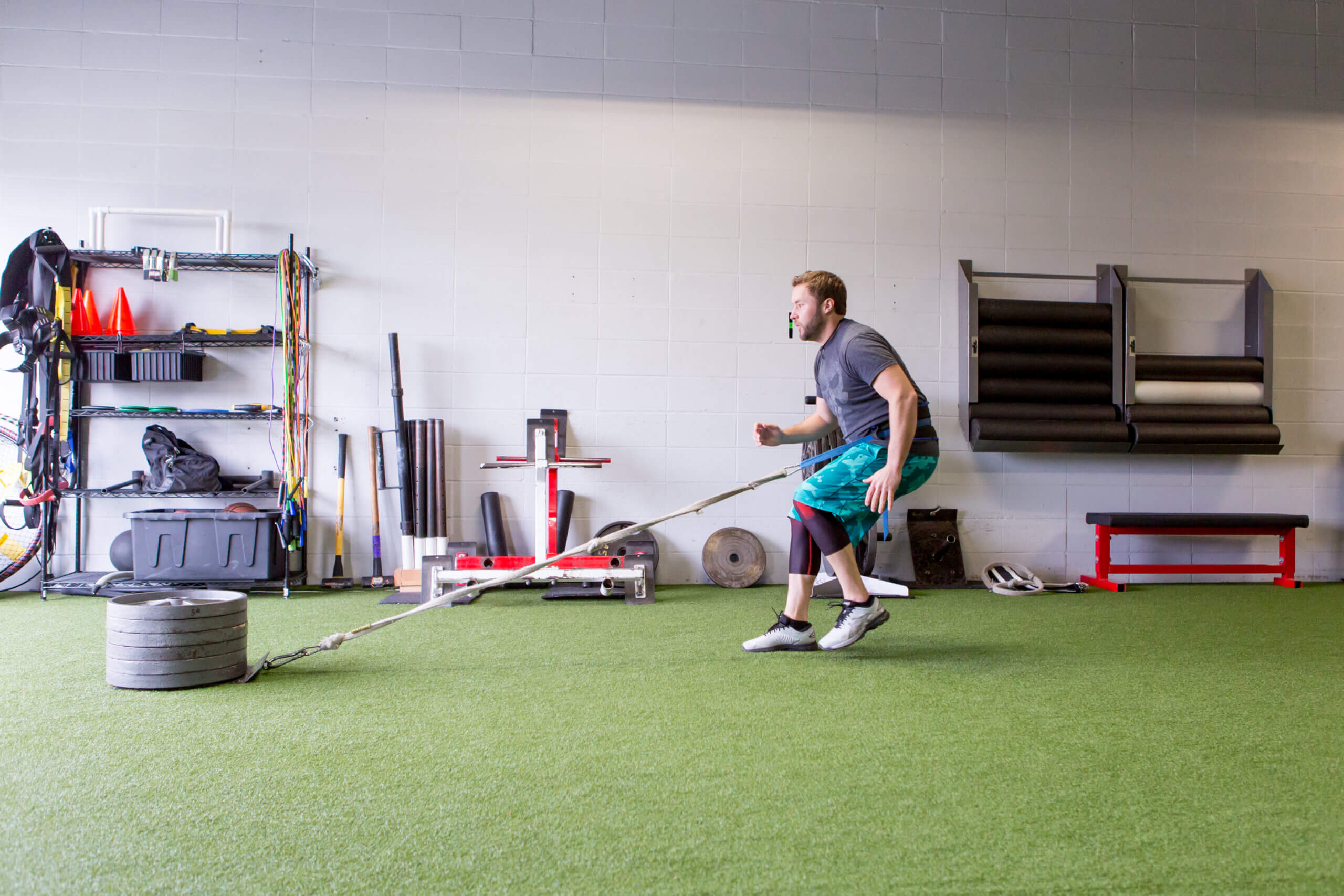 As trainers, we need to stop trying to fix pain and instead help people manage it in the broader context of improving fitness and health.
If there is an acute injury or trauma that causes local redness, swelling, or someone hears a ‘pop’, we should instruct individuals to seek out a medical professional.
However, people in persistent pain with prior or current physical therapy, sleep study, or trauma counseling interventions may be your typical client.
Working with someone who is already motivated and committed is easy, but people who are struggling also need your help.
Lack of movement can exacerbate pain and introducing a movement routine can improve blood flow, sleep, and help lubricate joints, so your role is important.
Working with general population clients, there seems to be two distinct mindsets,
- All pain is bad, so discomfort should be avoided at all costs and
- The productivity of a workout is based on the level of discomfort you feel throughout the workout, so I need to run at it through too much intense training
Neither of these are true, helpful, or predictive (Pope, 2023).
We need empathy and a willingness to explore the gray area instead of ignoring pain and continuing to train like you are 18 years old.
As trainers, we can help people reframe training from a mindset of ‘intensity is the sole driver of a productive workout’ to a ‘sustainable process that needs to be managed appropriately’.
Adaptive Upside Training
Persistent pain clients can surely benefit from strength training, but we want to make sure their training has the most adaptive upside.
Adaptive upside is a training concept that means making a positive change in a physiological variable to be able to withstand more challenge and stress, while minimizing negative consequences and managing trade-offs from those changes.
Your general population clients are not bodybuilders and surely do not need to be training like them as excessive loading may negatively impact their movement capabilities.
Adaptive upside training aims to improve a client’s strength, endurance, speed, and power, while considering and managing their movement quality.
Oftentimes, providing persistent pain clients with more movement options reduces pain symptoms by eliminating focal loading on a joint or reducing tension throughout the body.
A large part of adaptive upside training is to find positions that clients can execute exercises safely and that don’t restrict motion. Positional considerations and finding appropriate modalities can make a dramatic difference in persistent pain client’s success.
If you want to learn more about positional considerations, check out my FREE Ebook by clicking HERE. In this Ebook, I provide more detail for both communication strategies and changes in our training modalities when training clients in persistent pain.
Training Modalities
The gym can be an intimidating place for many.
Not only must you consider and validate your client’s fear, but you also may need to redefine for them what strength and conditioning looks like.
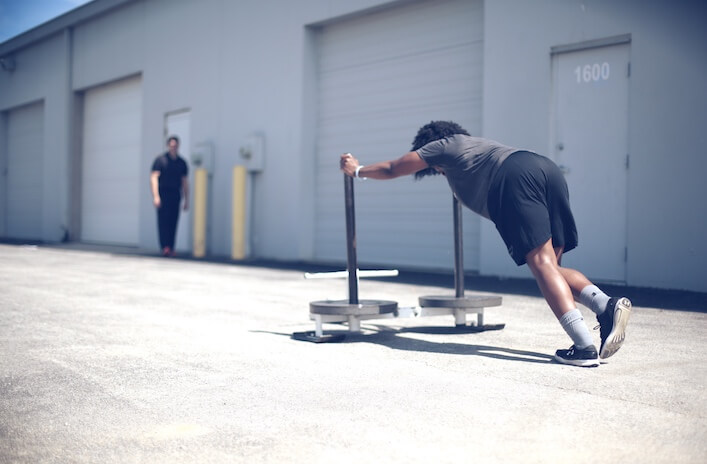 Many of your clients will benefit from ground-based and body weight exercises, generating enough of a stimulus to quickly improve fitness.
For others, machines may be a great option to drive intensity or an adaptive stimulus in a safe and effective manner.
Lastly, other modalities to consider include sleds, assisted exercises, or adding references or constraints to free weight exercises.
But most importantly, be creative and flexible in your training programs.
Utilize different pieces of equipment that provide support to exercises, allowing clients to perform exercises more successfully.
Be willing to make changes on the fly and adapt your training program when client’s come in with changes in their pain symptoms or stress.
Life and pain symptoms can be unpredictable so be willing to be flexible in your training plans if you want to keep your client’s working out even when they are in pain.
“A program only makes sense in the context of a person’s life.” – Dr. Tim Richardt
Coaching Strategies
We can teach our clients strategies, such as mindfulness, segmenting, and reframing, to get them through life, training, and continuing to push the boundaries of their physical existence. The aim is to help them keep moving forward through failure, stress, fatigue, and pain.
Here are a few strategies you might find helpful…
Mindfulness
Mindfulness is understanding where your attention is, how to redirect it, and how to manage yourself effectively in the moment.
It’s about not fixating on sensory information and just watching thoughts come and go.
We can teach our clients about mindfulness by directing them to sense and feel what is happening with their body during an exercise.
The goal would be to build awareness without fixating on or labeling a specific sensation or feeling. Fixation may lead them to feel overwhelmed and labeling the sensation may create negative associations.
Mindfulness does not have to include a meditation practice; it can be just building awareness of what is going on throughout the day.
Helping clients practice this skill will help them manage and make sense of their experience.
Once they develop some skills related to mindfulness, you can educate them about how stress will challenge their ability to focus and make decisions. Added stress such as a pain flare up will allow them to put their mindfulness skills into action.
Segmenting
What would your client like to be able to do well in day-to-day life?
Why are they coming to see you?
Once you determine why they are asking for your help, segment, or chunk that outcome into smaller steps that you can manage. Having your client reach more frequent achievements will improve their motivation.
Focusing on a small piece of the process instead of the overwhelming big picture goal will also provide a degree of control, thereby reducing stress.
Segmenting can be useful in long term planning and within each individual session.
Break a session down into smaller pieces, especially if the client is experiencing acute pain.
By saying, ‘let’s just focus on the first sets of the warm up’, then ‘let’s focus on completing the warm up’, you’re delivering more frequent successes to your client. This helps them manage expectations, shifts their attention, and provides a sense of control.
Ultimately this will help them become more process oriented and develop a skill to navigate stressful situations.
Reframing
Pain is not a question of IF but WHEN.
Reframing is injecting different variants of self-talk and perspective taking.
Something is going to hurt at some point in time; maybe something will hurt most of the time. We can help people accept this as inevitable, something to be understood and managed, as opposed to something that should be avoided at all costs.
Most clients fear getting hurt at the gym. There will be the inevitable tweaks, soreness, and aches, but gain their trust by setting proper expectations up front, to limit a client’s tendency to avoid.
For example, explain to your client that if they have a fear of public speaking they have to do it in a progressive way; speak to yourself, speak in front of someone you know, speak in front of a stranger, then speak in front of an audience.
To get over your fear of anything, you have to do it.
So you can’t get over a fear of movement without moving.
A great way to help clients reframe their experiences is to separate their identity from their feelings.
Instead of ‘I am tired’ or ‘I am in pain’ get them to reframe it as, ‘I am feeling tired’ or ‘I am feeling an intense burning in my leg’ (Pope, 2023). This perspective taking will help clients acknowledge the sensation without needing it to be who they are in the moment.
This is not ignoring their reality, but understanding and moving past it.
Summary
Our goal as coaches is not to solve pain.
 Instead, our goal is to help people manage, make sense of, and prosper through their pain experience.
We should not make promises about solving pain, but we should be willing to help people through their fitness journey in spite of pain.
This article is a compilation of the third season of the More Train, Less Pain; Engineering the Adaptable Athlete Podcast hosted by Dr. Tim Richardt and myself.
Tim and I explored lessons, tactics, and strategies that can help more effectively manage those in persistent pain that want to continue to move well, look great, and do cool stuff.
We had many great guests, including Bill Hartman, Mike Boyle, David Grey, Dr. Sam Leffers, Dr. Lisa Lewis, Dr. Seth Oberst, Jon Pope, Lucy Hendricks, and Tony Gentilcore.
I want to say a special thank you to Dr. Tim Richardt and our Season 3 guests for all of the great conversations, knowledge, and insights. If you want more insight, please check out our Season 3 episodes HERE.
If you want to soak up every detail about keeping your clients working out even when they are in pain, check out my FREE Ebook by clicking HERE. In this Ebook, I provide more detail and implementation strategies for helping persistent pain clients in their fitness and health journeys.
If you have any comments or questions please feel free to email me at [email protected]
About the Author
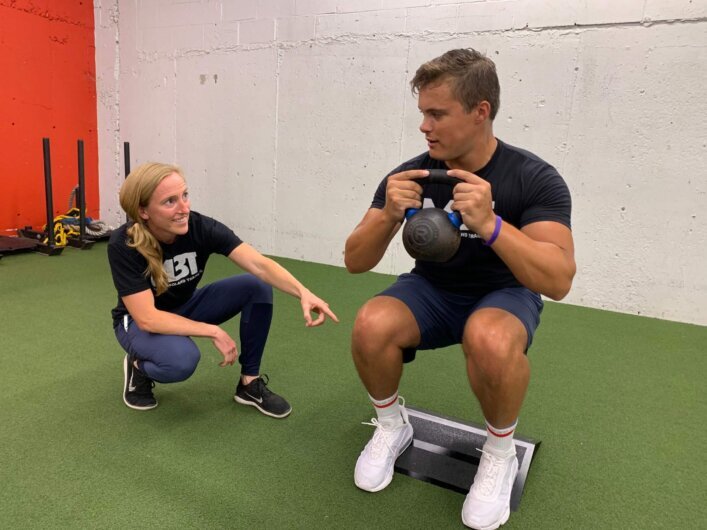 Dr. Michelle Boland
- Owner of Michelle Boland Training and Reframe Performance, Inc.
- PhD in Exercise Physiology, M.S in Strength & Conditioning, & B.S in Nutrition
- Instagram @dr.michelleboland
- Check out Michelle’s full Free Ebook on working with persistent pain clients!
References
Boland, M. & Richardt, T. (2023). More Train, Less Pain; Engineering the Adaptable Athlete Podcast.
Knutzen, K. et al. (2007). The Effect of High Resistance Weight Training on Reported Pain in Older Adults. Journal of Sports Science and Medicine, 6, 455-460.
Pope, J. & Richardt, T. (2023). More Train, Less Pain; Engineering the Adaptable Athlete Podcast. Season 3 Episode 2.
Rikard, M. et al. (2023). Chronic Pain among Adults- United States 2019-2021. Centers for Disease Control and Prevention MMWR, volume 72, number 15.