
Years ago, when Young Lance was just getting started coaching at IFAST, he was taking one of our new clients through a training session.
This girl was very petite, shifted way forward, and had a history of chronic lower back pain.
So Lance is trying everything in his playbook to get her to perform an RDL without back pain, and he’s failing miserably.
Now I’m off to the side minding my own business, getting warmed up for my workout, and I’m watching this whole thing unfold.
It was kind of like watching a train wreck, but I’ve always been a big believer in letting coaches learn from experience 😉
So Lance is trying really hard to get her to hinge without pain, and it’s just not working.
And being the great guy that I am, I step in and try to help them both out.
But you know what happened?
I failed miserably myself!*
As I was licking my wounds and admitting defeat, I did come to a strong realization:
For certain clients and athletes, some exercises just aren’t worth the time.
Now would I have loved for her to walk out with a clean hinge pattern?
Absolutely.
But for this client, it just wasn’t in the cards.
Along those same lines, would I like everyone to have the ability to squat and hinge equally well?
For sure.
But unless you’re training a powerlifter or Olympic lifter, there are no exercises you HAVE to do in the gym.
If you’re training a gen pop client or athlete, and they can’t squat the best, or can’t hinge as well as you’d like, so what?
The goal is to get them a training adaptation. Period.
Fat loss.
Hypertrophy.
Strength development.
Power production.
Now as coaches, we might WANT to choose certain exercises.
Because we like them.
Because we’ve had success with them.
Because any number of other reasons, really.
Or we might WANT to have clients that are competent in ALL of the movement patterns.
And while I respect that, it might not be reality.
So here’s the main theme for this article:
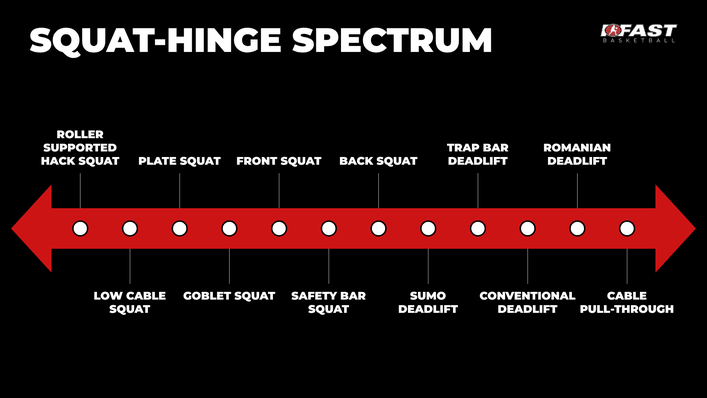
On the Squat-Hinge Spectrum, most clients will be biased one way or the other and are rarely “balanced” between the two patterns.
Let’s use some graphics to help me explain this.
Above is the most current version of my my Squat-Hinge Spectrum.**
While I’d love to think that every client can run this from end-to-end, in my experience, there are very few people (if any) who can do this without compensation.
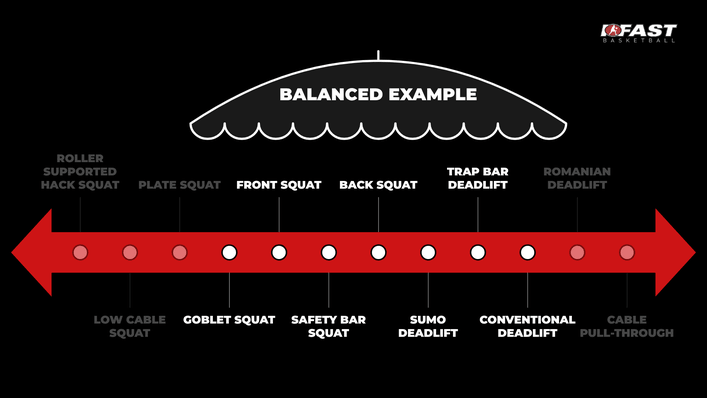
Instead, if you find someone that is truly “balanced,” here’s what their exercise selection might look like:
However, what I’ve seen over the past 26 years is that most clients/athletes will have a bias towards squatting OR hinging.
Bill might describe this as your narrow (squatting/ER) archetype, versus your wide (hinging/IR) archetype.
Maybe I’m just old-school, but back in the early 2000’s I just labeled them as “squatters” or “hingers,” so let’s stick with that for now!
Now if you know what kind of client is standing in front of you, you can bias their program in a way that immediately gives them more success.
If a specific client or athlete does better with squat variations, keep them on the left-hand side of the continuum.
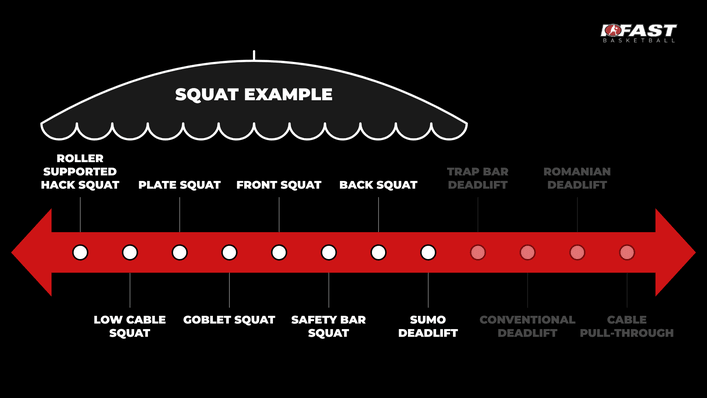
These are those people that make everything look clean when they’re tall and upright, but the second they have to shift their hips and pelvis back, they turtle up and round their back.
On the flip side, some clients will make everything look like a hinge.
I’m a great example here – try as I might, I’m never going to have that super clean, upright, squatty looking squat.
So while I’ll try and keep as much mobility as I can for squatting, if I need loading, I’m going to shift to exercises on the right.
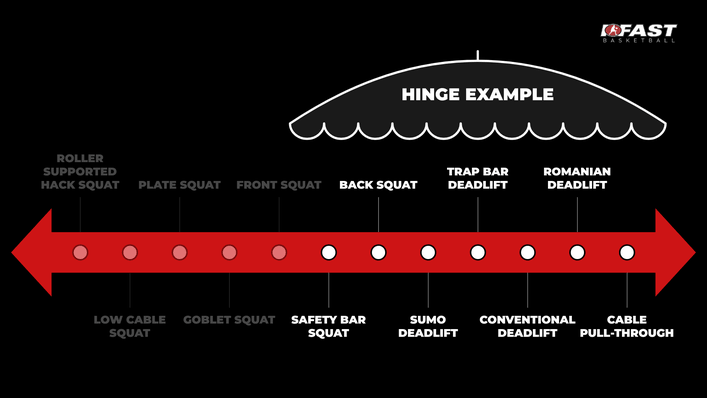
Now the final point I want to make here is that while I’ve given arbitrary bands of exercises to hypothetical clients, just understand that in the real world, all of this is gray.
Some people will be biased more one way than others.
Some will have a really wide range of exercises available to them, while others will be very narrow.
Unfortunately, program design and coaching aren’t as easy as following a recipe.
But once you hgave a better understanding of the client standing in front of you, as well as their movement tendencies, hopefully you can start to make more educated programming choices going forward!
All the best,
MR
BTW – if you want to learn more stuff like this, be sure to check out my Complete Coach Certification. It’s on sale for 20% off (my lowest price EVER) through next Monday at midnight!
* The consolation prize was I created the “band-resisted hip hinge” you’ve probably seen in my videos and the certification – but I definitely wasn’t feeling good about it at the time!
** I’ve seen a lot of people straight up copying older versions of this, using the exact same examples, slapping their logo on it, and posting it to IG. I’m all for sharing content but please give credit where credit is due por favor!