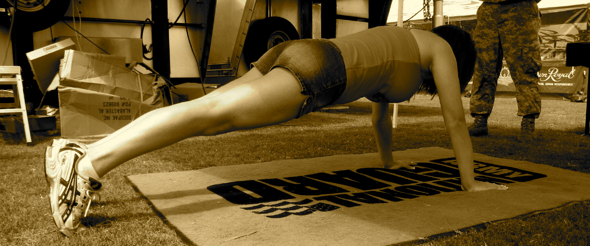
Push-ups are easy. After all, you just plop down on the floor and press yourself up, right?
Not so fast.
Many use push-ups to develop their upper body, especially the pressing muscles like the pecs, deltoids, triceps, etc. However, we also know that they’re great for development of the muscles surrounding the scapulae and the rotator cuff, too.
But if our only goal is to develop the big, showy muscles of the upper body, why not just bench press?
The inherent value of performing push-ups from a total body perspective is that they force you to stabilize your entire body. We know that many people suffer from core weakness or instability, and push-ups definitely put those issues on display.
In my opinion, push-ups are not only a great real-world, functional assessment, but an exercise that most should have in their training programs.
Here’s a quick video of how you can improve the stabilization patterns in your push-ups. I’m going to make it a priority to use more video for all you visual learners out there, so hopefully you enjoy the video (and a bit of humor as well!)
While this video is short and sweet, I hope it adds another tool to your coaching toolbox.
What other cues do you guys and gals use to improve people’s stability while doing push-ups?
I look forward to your thoughts and comments below!
Stay strong
MR
(Lead photo courtesy of Katy Warner)
Related Posts
No related posts.


I add the floor plank into someone's program if they're not keeping a solid posture. I want them to get use to keeping the body tight and why not from a basic static position?
That and "rotating" the elbows inwards to prevent them from excessively flaring outwards.
Great video; very concise.
Fantastic cues Niel – thanks!
I think one of the biggest notes on this post is the importance of video as an assessment tool. Great post Mike!
Exactly – I'm trying to get more and more video. Makes for great before/afters as well
Thanks Smitty!
Smitty, Mike,
I agree that video is an excellent "belief check" that I need to begin to implement a little more frequently in my own coaching and not with just online consults. I remember Vern Gambetta speaking about how he occasionally uses Dartfish to keep himself honest, which is probably a fairly good practice.
Regards,
Carson Boddicker
I don't have Dartfish, but even basic video is better than nothing!
What's your opinion on "pulsing" pushups? Since implementing these, they seem to have been working for our ladies and kids, many of whom couldn't do a single decent pushup starting out. We'll tell the athlete to limit the body's pulse amplitude to only a couple of inches, but as the set progresses they sometimes increase the range subconsciously (while maintaining posture), which is pretty cool to watch. The ladies seem to like this method since they have been stuck with doing "girl" pushups forever with limited progress toward "real" pushups or have struggled through "real" pushups with crappy form (and feeling like crap too!).
Also, since we're often dealing with triathletes and swimmers, we wanted a way to clean up the FMS pushup pattern without tiring out the arms for the next day's swim (or sometimes the arms are tired from a previous swim).
I have not tried this before – do you do them in the top position? Or at the midpoint, more like an ISO?
Let me know and thanks for the comment!
Top position. Some of these ladies with an FMS "1" can barely get off the ground in week 1, so the mid-point is probably a little tough for them as a starting point. Now that you mentioned the ISO's, as their strength progresses I think we should definitely integrate some ISO work at the midpoint to hit the "bottom-up" aspect , much like a corrective progression for a squat, I suppose.
Great work Mike, really like the layout of the video.
One cue I use that seems fairly effective is to ask the client to imagine isometrically "externally rotating and spreading" their palms as they perform their pushup. I find this helps them to engage the upper back and stabilize the shoulder. When doing incline pushups I ask them to imagine "bending and spreading the bar" as if they were trying to supinate the wrist.
Great cues Dan – I always forgot about screwing or externally rotating the shoulders. I need to use that one more.
Great vid, Mike. However, just wish to point out that despite Gabe's improvement, he still has a bit of elbow flare compared to your pushup. I think it's important as a coaching cue to keep elbows tight to the body. Of course, your point here was about stabilization and you did a great job of making it. Thanks!
One thing at a time Paul – one thing at a time
Really like your new "vlog" format
And the new comment section is really well-arranged aswell. Well done.
Thanks Ernie – I'm always trying to improve the functionality of the site. Glad you like it!
MR
I notice that your forearms stay perfectly perpendicular to the ground during the entire rep. When I do this, I feel an enormous amount of pressure in both of my wrists. Is there anything you recommend to alleviate this? Or, is it okay for the forearms to angle back towards the legs slightly (maybe 5-15 degrees)?
I find some of my clients also have this issue. Pain in the wrist when doing push ups.
Mike, do you know of a good resource to treat wrist and forearm pain?
If it's an ongoing issue, get it checked out by a sports med practitioner.
In the interim, though, try getting them out of hyperextension at the wrist. We use stands similar to the ones below to get them into a neutral alignment, and prevent that wrist extension:
http://cdn2.ioffer.com/img/item/331/602/26/net2fi…
Hope that helps. Good luck!
Hey Mike,
Ben VL here. I have regressed a few clients back to the squat cage after your tips re: eccessive APT. It has helped a lot. I find for clients that fall into APT during the pushup, to do a few cat camels before they start and tell them, "thats what I want to see when I say tuck your hips" (re: posterialy tilting the pelvis). Sometimes when I say " tuck your hips" they go deeper into APT. I find it's good to tell them what you want to see every 2-3 reps before you start the set.
Cheers Mike,
Ben
Dear Mike,
I really like your break down and analysis of one of the basics that should be in everyone's program. I use the push up as an initial assessment tool to look for the imbalances you described. Thank you for all of your guidance!
In Health and Happiness,
Nick Outlaw
Thanks Mike – the video is a great help! What do you do for someone who has major strength differences between right and left?
Linda
Linda –
You're a case where you may actually NEED some dumbbell pressing first and foremost to iron out side-to-side asymmetries.
It's not ideal, but I would address the strength imbalance first and foremost.
Good luck!
MR
Mike – Great stuff as always!
Love the PVC pipe work! Also makes sure that longus coli/capitus are properly able to stabilize the neck, otherwise, the head would be leaving the pipe at the bottom of the push-up.
The videos are very helpful! Give us more!
Absolutely Christopher! I try and remind people that “neutral spine” means C-spine as well, not just thoracic and lumbar.
Thanks for the kind words!
MR
Besides the already mentioned tip of screwing hands into the floor, another tip is to focus on keeping your weight on the outer part of your palm, close to the wrist (below the little finger.) This might also help those who feels wrists pain when doing pushups.
Sergei –
Another great follow-up tip. Thanks!
MR
Great video and sound is perfect here
I have a client (female) who is tall and has a very long torso. She cannot even come close to doing a proper push-up without engaging her upper traps, allowing her head to sag and her lower back to arch. She also has a very anterior posture in a static standing position. Where do you start with someone like this? Thanks!
Put them in a power rack and have them do push-ups on an incline. This is the best way to unload the movement but still train the pattern.
Great question!
MR